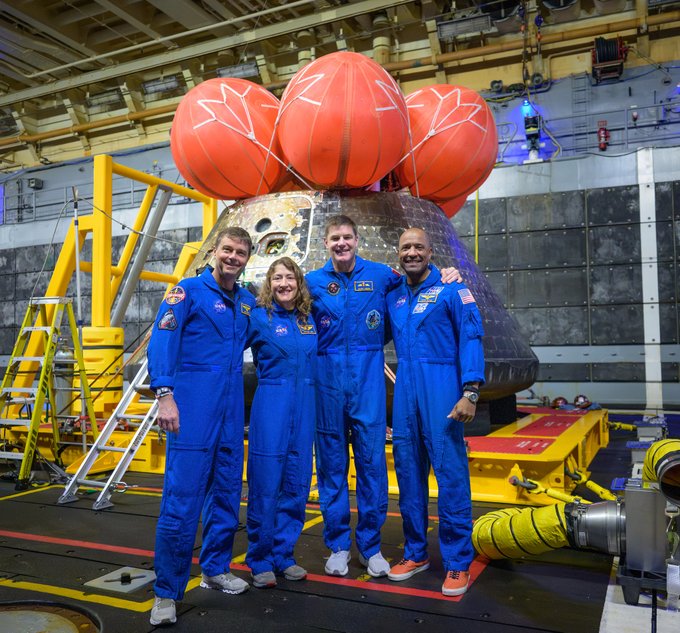
Historic Return Marks New Era of Lunar Exploration
On April 10, 2026, at 8:07 p.m. EDT, the four astronauts of Artemis II safely splashed down in the Pacific Ocean off the coast of San Diego aboard the Orion spacecraft, successfully completing a historic journey around the Moon.
The mission lasted about ten days and marked humanity’s first crewed lunar voyage in more than 50 years since Apollo 17. The safe return represents a major milestone for NASA and its Artemis program, which aims to return humans to the lunar surface and establish a long-term sustainable presence on the Moon before eventually sending astronauts to Mars.
The successful splashdown triggered celebrations across the global space community and renewed excitement about the future of deep space exploration.
The Crew Behind the Historic Mission
The Artemis II mission brought together a diverse and highly experienced international crew, symbolizing a new chapter in human spaceflight and global cooperation.
Reid Wiseman served as commander, bringing experience as a U.S. Navy test pilot and a veteran astronaut who previously spent time aboard the International Space Station. Victor Glover piloted the mission, becoming the first Black astronaut to travel into deep space, a historic achievement in itself.
Christina Koch took on the role of mission specialist, building on her record-breaking 328-day stay on the International Space Station and becoming the first woman to fly around the Moon. Jeremy Hansen, representing the Canadian Space Agency, served as mission specialist and made history as the first non-American astronaut to participate in a lunar mission.
Together, the crew reflected a more inclusive and internationally collaborative approach to space exploration compared to the Apollo era.
A Critical Test Mission for the Artemis Program
Artemis II was designed as a crucial crewed test flight following the success of Artemis I, which flew the Orion spacecraft around the Moon without astronauts in 2022.
The crew launched aboard the massive Space Launch System from Kennedy Space Center and traveled more than 694,000 miles during the mission. At its farthest point, Orion reached approximately 252,756 miles from Earth, surpassing the record set by Apollo 13 and becoming the farthest distance humans have traveled in space.
The astronauts followed a free-return trajectory around the Moon, flying past the far side and capturing stunning new views of the lunar surface, including the Orientale basin. The mission allowed NASA to test life support systems, navigation, communication, and radiation protection while operating in deep space.
Christina Koch described the far side of the Moon as absolutely spectacular, highlighting how different it looked compared to previous images and reinforcing the importance of human presence in space exploration.

Safe Reentry and Pacific Splashdown
As Orion returned to Earth, it reentered the atmosphere at extreme speeds, reaching approximately Mach 33. The spacecraft’s advanced heat shield endured intense temperatures before parachutes deployed to slow the capsule for a controlled splashdown in the Pacific Ocean.
Recovery teams quickly secured the capsule and safely extracted the astronauts, who were reported to be in good health. They were then transported by helicopter to the USS John P. Murtha for initial medical checks before being flown back to Houston for post-mission evaluation and debriefing.
The smooth landing and recovery confirmed the reliability of Orion’s systems and demonstrated NASA’s readiness for future crewed lunar missions.
Paving the Way for Future Moon Landings
The successful Artemis II mission provides critical data on human health in deep space, spacecraft performance, and the lunar environment, all of which will support future missions such as Artemis III, which aims to land astronauts on the Moon.
NASA officials have emphasized that Artemis II represents a stepping stone toward long-term lunar exploration and eventual missions to Mars. The mission proves that humans can once again travel safely beyond low Earth orbit and operate in deep space for extended periods.
With Artemis II completed successfully, the Artemis program moves closer to its goal of establishing a sustainable human presence on the Moon and inspiring a new generation of explorers.
A Mission That Inspires the World
The safe return of the Artemis II astronauts marks a historic moment not only for NASA but for humanity as a whole. The mission demonstrated international cooperation, technological advancement, and the enduring human desire to explore beyond Earth.
As the crew returned home to a hero’s welcome, their journey served as a reminder that the future of space exploration is no longer a distant dream but a reality steadily unfolding, bringing humanity one step closer to living and working in deep space.
Also Read
Artemis II: Humanity Returns to the Moon with Historic Lunar Flyby