Trump Targets Pope Leo XIV in Fiery Late-Night Post
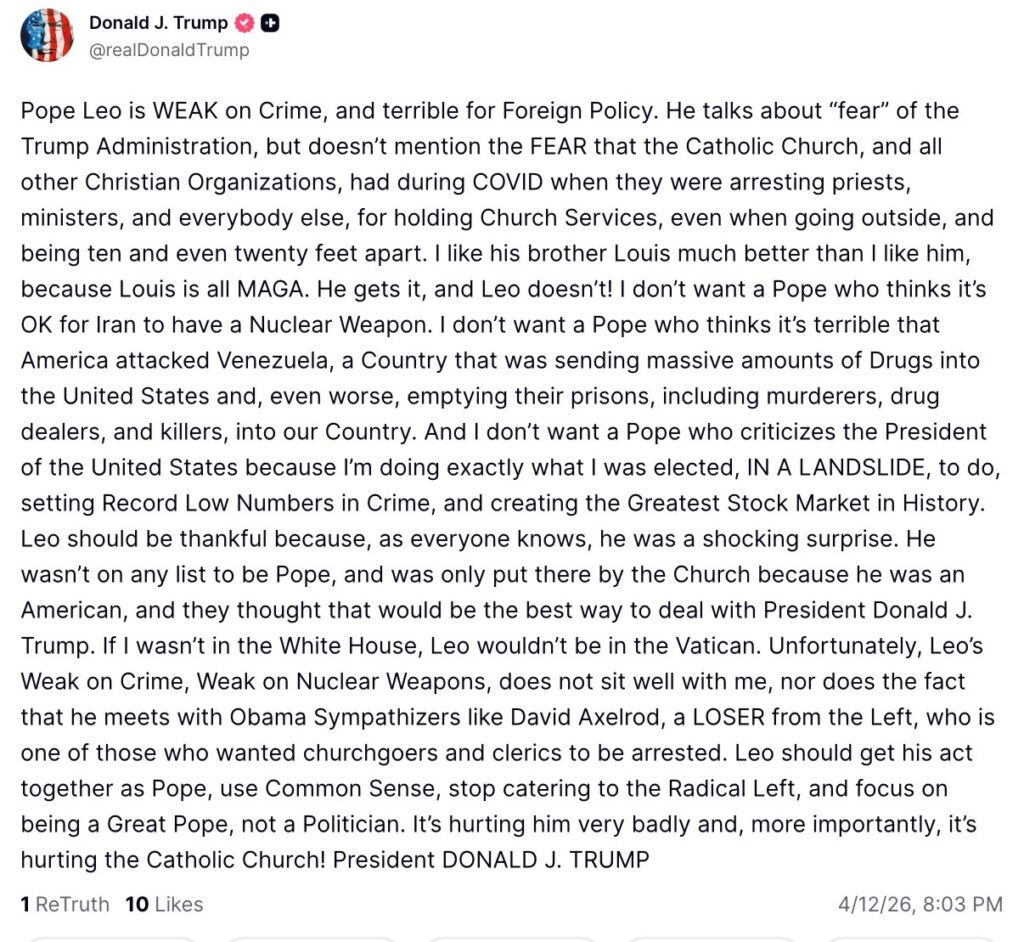
U.S. President Donald Trump ignited fresh controversy on April 12, 2026, after publishing a lengthy and sharply worded post on Truth Social attacking Pope Leo XIV.
Posted at 8:03 PM, the message delivered a deeply personal critique of the pontiff, marking one of the most direct public confrontations between a sitting U.S. president and the head of the Catholic Church in modern history.
Trump described the pope as “weak on crime” and “terrible for foreign policy,” accusing him of poor leadership and aligning with political interests rather than spiritual priorities.
Personal Jabs and Political Accusations
The post quickly escalated beyond policy disagreement into personal territory. Trump accused Pope Leo XIV of hypocrisy, particularly over remarks about fear under the Trump administration. He contrasted this with what he described as widespread fear among religious communities during COVID-19 restrictions, when church gatherings were limited.
In a striking comparison, Trump said he preferred the pope’s brother, Louis Prevost, calling him “all MAGA” and suggesting he understood political realities better than the pontiff.
Trump also took aim at the pope’s positions on key global issues. He criticized Leo’s stance on Iran and opposition to U.S. actions in Venezuela, arguing that such views ignored national security concerns and criminal activity linked to those regions.
Defending his own leadership, Trump pointed to what he described as record-low crime levels, a booming stock market, and a decisive electoral mandate as justification for his policies.

A Bold and Controversial Claim
Among the most striking elements of the post was Trump’s claim that Pope Leo XIV’s election in 2025 was influenced by his own presidency. He suggested the Catholic Church selected an American pope as a strategic move to deal with him, adding that Leo would not be in the Vatican if he were not in the White House.
The assertion, widely viewed as hyperbolic and unsubstantiated, underscored Trump’s tendency to frame global events through a personal and political lens.
He further accused the pope of engaging with figures he described as “Obama sympathizers,” including political strategist David Axelrod, and urged Leo to “stop being a politician” and focus on his role as a spiritual leader.
Roots of a Growing Rift
The outburst is the latest chapter in an escalating feud between Trump and Pope Leo XIV that has unfolded throughout early 2026.
At the center of the tension is the ongoing Iran conflict. Trump has taken a hardline stance, issuing strong warnings and signaling potential military escalation. In contrast, Pope Leo has consistently called for restraint, dialogue, and peace, condemning the human cost of war and what he views as dangerous rhetoric.
The pope has also criticized threats against Iran as “unacceptable,” positioning himself as a vocal advocate for diplomacy and humanitarian considerations.
These opposing worldviews have increasingly put the two leaders on a collision course.
A Rare Clash Between Power and Faith
While disagreements between political leaders and the Vatican are not new, the public and personal nature of this exchange is highly unusual. It is rare for a U.S. president to directly attack the pope in such explicit terms.
The clash is particularly notable given that Pope Leo XIV is the first American-born pontiff, a factor that has added an extra layer of political and cultural significance to the dispute.
Trump’s closing remark captured the tone of the post: a warning that the pope’s approach was “hurting him very badly” and, more importantly, damaging the Catholic Church itself.
Why This Moment Matters
The episode highlights a deeper ideological divide between two influential figures shaping global discourse in very different ways.
On one side is Trump’s emphasis on strength, national security, and assertive foreign policy. On the other is Pope Leo XIV’s focus on peace, compassion, and moral restraint in global affairs.
The fallout has already drawn widespread media attention, reflecting not just a personal feud, but a broader clash between political power and religious authority in 2026.
In many ways, the exchange encapsulates a defining tension of the moment: competing visions of leadership in a world marked by conflict, uncertainty, and sharply divided perspectives.
Also Read
Pope Leo XIV’s Strong Anti-War Message Gains Urgency Amid Global Conflicts
Israel Reportedly Plans Special Peace Prize for Donald Trump Amid Strong Ties with Netanyahu