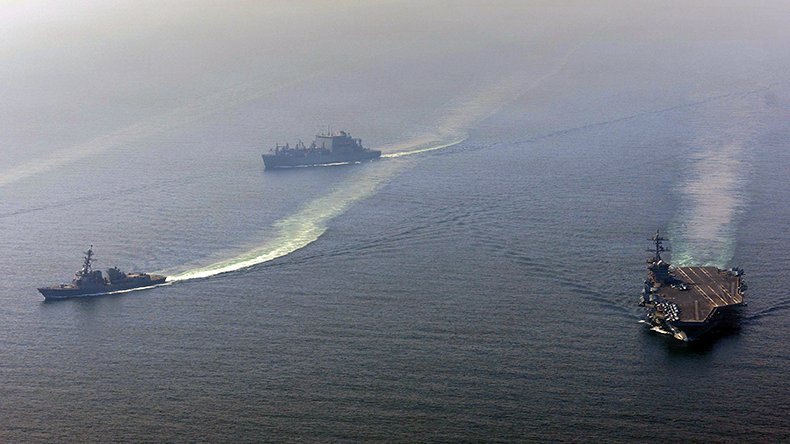
US Signals Possible Naval Escorts in Strait of Hormuz as Shipping Crisis Deepens
The Strait of Hormuz the narrow maritime corridor through which roughly 20% of the world’s oil and gas supplies pass has become the latest flashpoint in the escalating US–Israel conflict with Iran. As of March 4, 2026, commercial shipping traffic through the strait has slowed dramatically amid mounting security threats, disrupted navigation systems, and rising insurance costs.
Iran’s Islamic Revolutionary Guard Corps (IRGC) has issued warnings about potential attacks on vessels in the region. At the same time, widespread GNSS (GPS) jamming has complicated navigation, while major insurers have withdrawn new war-risk coverage for ships entering the area. The result has been a de facto shipping freeze, with dozens of large tankers anchored in the Gulf of Oman waiting for clarity before attempting transit.
US Navy Initially Rules Out Escorts
On March 2, US Navy officials briefed senior shipping industry representatives after repeated requests for convoy-style protection. According to industry sources, the Navy made clear that there were no naval escorts available for tankers transiting the Strait of Hormuz and no timeline for when such protection might become feasible.
The position reflected operational strain. The Navy is currently managing multiple global commitments, and providing sustained escort coverage in a high-threat environment like Hormuz would require significant assets, coordination, and air-defense capabilities.
Shipping executives described the briefing bluntly, characterizing the response as leaving “no chance” of immediate escorts.
Trump Announces Policy Reversal
Less than 24 hours later, President Donald Trump announced a dramatic shift in tone and policy. In a statement posted to Truth Social on the evening of March 3, he outlined two measures aimed at restoring maritime traffic and stabilizing global energy markets.
First, he directed the United States International Development Finance Corporation (DFC) to provide political risk insurance and financial guarantees for maritime trade transiting the Gulf, particularly energy shipments. The coverage, he said, would be offered “at a very reasonable price” and made available to all shipping lines.
Second, Trump stated that “if necessary,” the United States Navy would begin escorting tankers through the Strait of Hormuz “as soon as possible.”
In his remarks, the president pledged that the United States would ensure the “free flow of energy to the world,” signaling urgency to prevent further market disruption.
Current Status: No Escorts Yet
Despite the announcement, no US naval escorts are currently operating in the strait. As of March 4, the Pentagon has not released operational details or a confirmed timeline for deployment. While the presidential statement overrides earlier Navy messaging, establishing escort convoys would require logistical coordination and asset allocation that cannot occur instantly.
Tanker movements remain sparse and cautious. Some smaller vessels have attempted crossings, and a few larger suezmax tankers have reportedly transited at night with AIS (Automatic Identification System) signals switched off. GNSS interference remains widespread, raising safety risks.
Meanwhile, dozens of large crude carriers remain queued outside the Gulf, reluctant to proceed without security assurances. Greek shipowners are reportedly weighing the risks of high-stakes voyages without escorts, betting on quick port turnarounds. Insurers have largely suspended new war-risk extensions for the area, although policies already in force for vessels inside the Gulf are being honored.
Energy Markets on Edge
The rapid policy shift underscores Washington’s concern about a potential energy shock. Oil prices spiked sharply following the shipping freeze but moderated slightly after Trump’s announcement. Brent crude opened around $80 per barrel on March 3 elevated but not yet at crisis levels.
The situation has drawn comparisons to the 1980s “Tanker War,” when the US reflagged Kuwaiti vessels and provided naval escorts during the Iran–Iraq conflict. Whether today’s US Navy can mobilize similar convoy protection in short order remains uncertain.
For now, shipping companies, insurers, and energy traders are watching closely. Any confirmed deployment of US naval escorts in the Strait of Hormuz would represent a significant escalation and a decisive signal that Washington intends to secure one of the world’s most critical energy chokepoints by force if necessary.