Trump Announces Sudden Naval Blockade
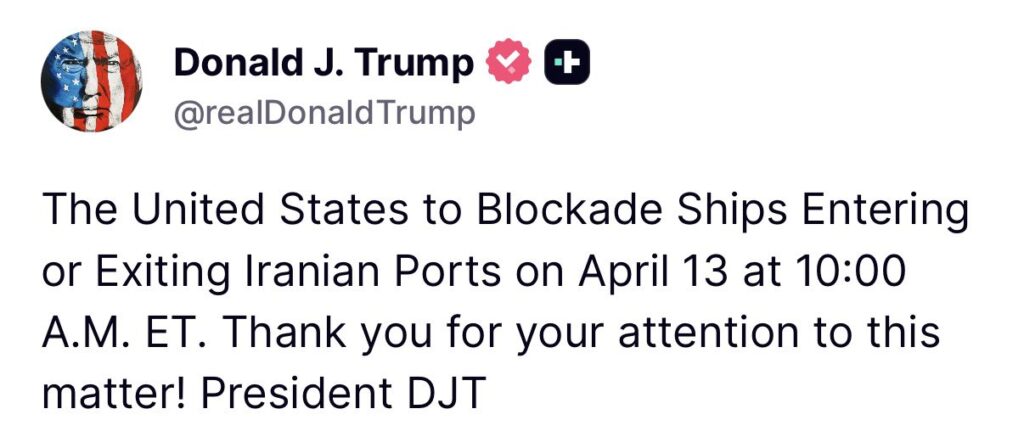
On April 13, 2026, U.S. President Donald J. Trump issued a brief but consequential statement on Truth Social, declaring that the United States would begin blockading ships entering or exiting Iranian ports at exactly 10:00 a.m. Eastern Time.
The announcement, delivered in Trump’s signature direct style, signaled a sharp escalation in the already fragile standoff between Washington and Tehran, marking a new phase in the ongoing 2026 Iran conflict.
Collapse of Peace Talks Triggers Shift
The decision followed the breakdown of high-stakes negotiations between U.S. and Iranian officials held in Pakistan over the weekend. The talks had aimed to stabilize a fragile ceasefire that emerged after earlier U.S. and Israeli strikes on Iranian targets tied to its nuclear program.
While both sides reportedly made progress on several issues, the central dispute over Iran’s nuclear ambitions remained unresolved. Trump later indicated that this sticking point ultimately derailed the negotiations, prompting a pivot from diplomacy to direct military pressure.
U.S. Military Moves to Enforce Blockade
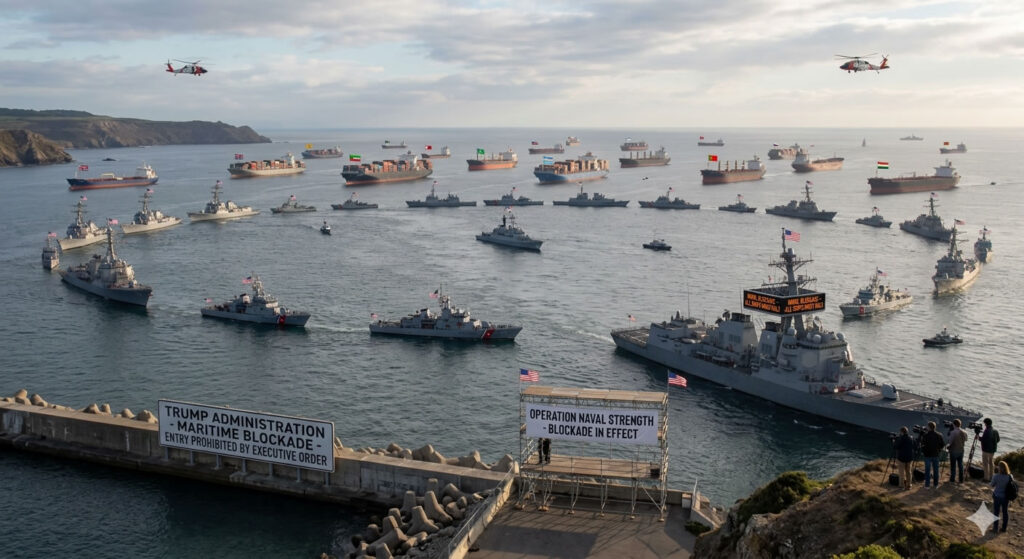
Shortly after the announcement, United States Central Command moved to formalize the directive. U.S. forces began preparations to enforce a maritime blockade targeting all vessels entering or leaving Iranian ports.
The operation focuses on Iran’s coastal infrastructure along the Persian Gulf and the Gulf of Oman, aiming to disrupt trade and, critically, oil exports that form the backbone of Iran’s economy.
However, officials clarified that the measure stops short of a full closure of the Strait of Hormuz. Ships traveling between non-Iranian ports are still permitted to pass, suggesting a calibrated approach designed to apply pressure while avoiding a total shutdown of global shipping routes.
Oil Markets React Immediately
Global energy markets responded within hours of the announcement. Oil prices surged sharply, with major benchmarks climbing above the $100 mark amid fears of supply disruptions.
The Strait of Hormuz remains one of the world’s most critical oil transit routes, historically carrying around a fifth of global petroleum shipments. Even a partial disruption has significant ripple effects, and early reports indicated that shipping traffic in the region slowed as companies assessed the risks.
Iran Signals Retaliation
Iranian officials reacted swiftly, warning of potential countermeasures. Elements within the Islamic Revolutionary Guard Corps signaled readiness to respond, including threats to target ports across the Persian Gulf and Gulf of Oman.
Such actions could broaden the conflict beyond Iran and the United States, potentially drawing in neighboring Gulf states and increasing the risk of a wider regional confrontation.
A Calculated but Risky Strategy
The blockade reflects a classic strategy of economic warfare, aimed at weakening an adversary without immediately resorting to full-scale military invasion. By targeting Iranian ports rather than international waterways, the U.S. seeks to cut off revenue streams, limit resupply capabilities, and demonstrate resolve after failed diplomacy.
At the same time, the move carries substantial risks. Naval confrontations, accidental clashes, or retaliatory actions such as mining shipping lanes could quickly escalate tensions. Legal questions surrounding freedom of navigation under international maritime law may also come into play.
Global Tensions on a Knife Edge
As of April 13, 2026, the situation remains highly fluid. The fragile ceasefire appears increasingly at risk, and global leaders are watching closely for signs of further escalation.
Trump’s short but decisive announcement underscores his approach to foreign policy: combining clear deadlines with maximum pressure. Yet the stakes are immense, with potential consequences for global energy markets, regional stability, and international security.
What began as a diplomatic impasse has now shifted decisively into a confrontation at sea, raising the prospect of a conflict that could reshape the geopolitical landscape in the months ahead.
Also Read
US-Iran Talks in Islamabad End in Deadlock After Marathon Negotiations
Trump Issues Stark Ultimatum to Iran Over Strait of Hormuz as Deadline Looms